
Why Students Disengage Before Anyone Notices
A clarity-based framework for understanding first-year disengagement, drift, and persistence risk
By Rodney Goldston
Opening Note: The Problem We Keep Seeing Too Late
Colleges rarely lose students all at once.
More often, they lose them in quiet increments.
A missed assignment.
An unanswered email.
A meeting never scheduled.
A class skipped once, then twice, then often enough that returning begins to feel embarrassing.
From the outside, these behaviors can look like irresponsibility, low motivation, poor time management, or lack of seriousness. But inside the student, something more complex may already be happening. A private interpretation is forming.
Maybe I am not ready.
Maybe I do not belong here.
Maybe I have already fallen too far behind.
Maybe this program is not for people like me.
By the time an institution sees disengagement clearly, the student may have already reached an internal conclusion. The exit may not be official yet, but psychologically, the leaving has begun.
This is the hidden transition gap.
It is not simply the gap between high school and college. It is the gap between externally structured environments and self-directed expectations. It is the behavioral and psychological space students enter when the familiar scaffolding of prior educational systems falls away and they are expected to navigate ambiguity, pressure, independence, and institutional complexity before they have fully developed the internal architecture to do so.
Many students do not disengage because they lack aspiration. Many arrive with goals, family expectations, career hopes, and a desire to succeed. They disengage when clarity erodes. When confidence weakens. When initiative stalls. When connection thins. When uncertainty begins to sound like evidence.
The problem is not always that students do not care.
Sometimes the problem is that they cannot clearly see the next move.
And when people cannot see clearly, they often do not move boldly. They hesitate. They avoid. They drift.
This report introduces The Hidden Transition Gap™ as a practical framework for understanding student disengagement before it becomes visible in the usual institutional data. It is designed for higher education leaders, student success professionals, coordinators, advisors, and program builders who are looking for language, structure, and insight to explain a pattern they may already recognize.
This is not a dissertation.
It is a clarity document.
Its purpose is to name what is often missed, explain how disengagement forms, and offer a more useful lens for intervention. Because if institutions only respond after students have stopped showing up, they may be arriving after the most important decision has already been made.
The work is not merely to react to departure.
The work is to interrupt drift.
Author’s Note: I Know the Gap Because I Lived It
I graduated from high school in 1985.
I graduated from Temple University in 1994.
There is a story inside those nine years.
It is not a story of laziness. It is not a story of low aspiration. It is not a story of someone who did not care about his future.
It is the story of a student trying to find his way through a system he did not always know how to navigate.
I started at Indiana University of Pennsylvania. I transferred to Hampton University, but did not complete my financial aid forms in time. I later decided to take classes part-time at Community College of Philadelphia. Eventually, I transferred to Temple University.
Then I got expelled for academics.
That sentence is easy to write now. It was not easy to live then.
When you are young, academic failure does not always feel like an event. Sometimes it feels like a verdict. It can make you question your intelligence, your direction, your discipline, and your right to be in the room. It can make you disappear from people who might have helped you because shame has a way of making silence feel safer than explanation.
But I got back in.
And I finished.
Looking back, I can see what I could not fully name at the time. I had ability. I had desire. I had a future worth fighting for. But I did not always have clarity, structure, institutional fluency, or the internal operating system required to keep moving when the path became unclear.
I knew how to want more.
I did not always know how to navigate toward it.
That distinction matters.
Many students are carrying ambition without a map. They are not empty. They are not indifferent. They are not without promise. But promise can get buried beneath confusion, fear, missed deadlines, misunderstood systems, weak feedback loops, and the private belief that everyone else knows something they do not.
I write this report not only as a strategist, author, and speaker.
I write it as someone who knows what it means to lose the thread and still have greatness left inside.
The Hidden Transition Gap™ is not abstract to me. I have lived inside the kind of gap this report describes. I know what it feels like when the institution keeps moving but the student is quietly losing direction. I know what it means to be capable and still unclear. I know what it means to fall out of sequence and wonder if the story is over.
It was not over.
That is why this work matters.
Because somewhere inside our institutions are students who still have a future, but are losing the clarity required to reach it.
They do not need us to lower the mountain.
They need us to help them see the next foothold before they turn around and walk away.
1. The Hidden Transition Gap™
The Hidden Transition Gap™ is the behavioral and psychological gap students experience when they move from highly structured educational environments into higher education systems that require greater autonomy, self-direction, help-seeking, and interpretation under pressure.
The gap is hidden because it often develops beneath the surface.
A student may still be enrolled.
They may still be attending some classes.
They may still say they want to succeed.
But internally, their relationship to the institution, their program, and their own future may already be weakening.
The transition into college is often described as an academic adjustment. But for many students, it is also an interpretation crisis. They are not only learning new material. They are learning how to read a new environment.
What does this syllabus really mean?
How much trouble am I in if I miss this deadline?
Who am I supposed to ask for help?
Is everyone else understanding this better than I am?
Does struggling mean I picked the wrong major?
Am I behind, or is this just what college feels like?
These questions matter because students do not respond only to what happens. They respond to what they believe those experiences mean.
A low grade can mean, “I need a new study strategy.”
Or it can mean, “I am not college material.”
A confusing advising process can mean, “I need to ask a better question.”
Or it can mean, “This place was not built for me.”
A difficult first semester can mean, “The transition is harder than I expected.”
Or it can mean, “I made a mistake coming here.”
The event may be the same. The interpretation changes everything.
The Hidden Transition Gap™ lives in that space between experience and interpretation.
For students who have been shaped by systems with tight feedback loops, this gap can be especially difficult. In many prior educational environments, students receive frequent reminders, direct correction, clear deadlines, visible structure, and immediate signals about whether they are on track. Higher education often operates differently. Expectations are more distributed. Consequences are delayed. Help may be available, but students must initiate the request. Resources exist, but the student must know when and how to use them.
The institution may believe support is present.
The student may experience the environment as unclear.
That difference matters.
The central claim of this report is simple:
Students are not primarily disengaging because they lack intelligence or aspiration. Many disengage when clarity, confidence, initiative, and institutional connection erode under reduced structure and increased ambiguity.
This does not mean academic preparation, finances, family obligations, mental health, or institutional barriers do not matter. They do. Community College Research Center researchers, for example, studied survey data from 480 former community college students who had enrolled in fall 2023 but left before fall 2024, emphasizing that departure is often shaped by overlapping academic, financial, stress-related, and institutional factors rather than one simple cause (Aguilar Padilla et al., 2025). But those pressures become even more difficult when students cannot clearly interpret what is happening, what options exist, and what next action is possible.
Clarity is not a soft concept.
Clarity is a persistence condition.
When students can see the path, understand the meaning of difficulty, and identify the next move, hope becomes possible. When they cannot, fear fills the gap.
That is where drift begins.
2. Why Traditional Persistence Language Is Incomplete
Higher education has developed a large vocabulary around student persistence.
Retention.
Completion.
Belonging.
Engagement.
Stop-out.
Dropout.
At-risk.
These terms are useful. Institutions need shared language to measure patterns, design interventions, and allocate support. But some of the most common words in the persistence conversation describe what has already become visible. They name the outcome more clearly than the mechanism.
A student is labeled disengaged after engagement has already declined.
A student is flagged as at-risk after risk has already accumulated.
A student is counted as stopped out after the student has already left.
National persistence and retention reporting helps institutions track early enrollment outcomes, including whether students remain enrolled into the spring term after initial fall enrollment and into the second academic year (National Student Clearinghouse Research Center, 2025). That data is necessary. But data that confirms departure or near-departure can still arrive after the internal decision has already started forming.
This creates a timing problem.
Institutions often detect the smoke after the fire has already moved through the walls.
The deeper question is not only, “Which students are at risk?”
The deeper question is, “What is happening inside the student before the risk becomes visible?”
That question moves the conversation from labels to mechanisms.
It asks leaders to look beneath behavior and listen for interpretation.
Because behavior is rarely the first signal. It is often the downstream expression of an internal story.
A student who stops attending class may not begin with a decision to disengage. The pattern may begin with confusion, then shame, then avoidance, then distance. Eventually, the student’s behavior tells the institution what the student’s internal narrative has already been saying for weeks.
This is why persistence work requires more than information delivery.
Many institutions already provide resources. Tutoring exists. Advising exists. Financial aid offices exist. Counseling exists. Faculty office hours exist. Student portals exist. Orientation exists.
But the presence of resources does not guarantee the student knows how to interpret their need, overcome hesitation, initiate contact, and use the support before their situation hardens.
Access matters.
But access alone does not close the gap.
A student can have access to help and still not ask for it.
A student can have access to information and still remain unclear.
A student can have access to opportunity and still wait to be chosen, called on, corrected, rescued, or redirected.
This is where traditional persistence language often runs thin. It can identify the student who is slipping, but it may not fully explain why the student did not grab the rope that was already hanging nearby.
The answer is often not laziness.
It is often ambiguity.
It is often fear.
It is often a collapsed sense of agency.
And that is why the next section turns to the pattern that appears before departure.
Students often do not leave first.
They drift first.
3. The Drift Pattern™: How Students Leave Internally First
Drift is not the same as failure.
Failure is visible.
Drift is quieter.
Failure often shows up in institutional records: grades, attendance, credit completion, probation status, registration holds, unpaid balances, or withdrawal forms. Drift begins earlier than that. It begins in the small space between what a student experiences and what the student decides that experience means.
A student misses one assignment.
Then another.
Then they avoid opening the course portal because the portal no longer feels like information. It feels like accusation.
A student receives a low grade.
Then they stop visiting office hours because they do not want to be seen as the student who is already behind.
A student is confused about financial aid, degree requirements, or advising instructions.
Then they delay asking for help because they assume everyone else already knows what to do.
From the outside, these may look like isolated behaviors.
Inside the student, they may be connected by a developing story.
The Drift Pattern™ names the progression that can happen before a student officially stops out, withdraws, or disappears. It is the internal pathway from small disengagement to eventual departure.
The pattern has four stages:
- Micro-Disengagement
- Narrative Formation
- Identity Shift
- Exit Decision
The purpose of naming these stages is not to reduce students to a formula. Human lives are never that simple. The purpose is to help institutions notice the early movement of disengagement while there is still time to intervene.
Stage 1: Micro-Disengagement
Micro-disengagement begins with small breaks in connection.
The student misses a class.
Skips a reading.
Does not respond to an email.
Stops checking the learning management system.
Leaves a form unfinished.
Avoids scheduling an advising appointment.
Misses a tutoring session they know they probably need.
On their own, these actions may not seem alarming. Students are human. They get tired. They get overwhelmed. They work jobs. They care for siblings or children. They commute. They manage family expectations. They wrestle with stress, money, belonging, identity, and the ordinary difficulty of becoming an adult.
The danger is not the single missed action.
The danger is what the missed action begins to mean.
Micro-disengagement becomes serious when the student starts interpreting a small break in performance as evidence of a larger personal deficit.
Not “I missed an assignment.”
But “I am falling apart.”
Not “I need help understanding this process.”
But “I should already know this.”
Not “This class is difficult.”
But “I am not built for this.”
This is the first quiet turn in the road.
The institution may see a student who needs a reminder.
The student may be experiencing the first fracture in confidence.
That distinction matters because reminders alone may not be enough. A reminder tells the student what they missed. It may not repair what they now believe about themselves.
Stage 2: Narrative Formation
After micro-disengagement comes narrative formation.
Human beings are meaning-making creatures. We do not simply experience events. We explain them to ourselves. When students encounter difficulty, they begin building a story about what that difficulty means.
A healthy interpretation might sound like this:
This is hard, but hard does not mean impossible.
I am behind, but I can recover.
I am confused, but confusion is a signal to seek clarity.
I need help, and asking for help is part of college success.
A dangerous interpretation sounds different:
I knew I was not ready.
Everybody else seems to get it.
I already messed this up.
I do not belong here.
This program is probably not for me.
I should just stop before I embarrass myself.
This is where drift becomes psychologically powerful.
The student is no longer responding only to a situation. They are responding to a story.
Once that story forms, every new experience gets filtered through it. A confusing email becomes further evidence. A low quiz grade becomes further evidence. A missed deadline becomes further evidence. Silence from an office becomes further evidence. Even a well-intentioned institutional message can be misread through the student’s growing narrative of inadequacy or disconnection.
At this stage, more information may not solve the problem if the student is interpreting information through fear.
The institution may say, “We sent the instructions.”
The student may think, “I am too far behind to use them.”
The institution may say, “Support is available.”
The student may think, “Support is for students who still have a chance.”
The institution may say, “Reach out if you need anything.”
The student may think, “If I have to ask, that proves I do not belong.”
Narrative formation is the moment when student success work must become more than procedural. The issue is not merely whether the student received the message. The issue is how the student interpreted the moment.
This is why language matters.
A coordinator, advisor, faculty member, or peer mentor may not need to solve the student’s whole life. But they can interrupt the wrong story before it hardens.
They can help a student move from:
“I am failing.”
To:
“I am in a recoverable moment.”
From:
“I do not belong here.”
To:
“I am in a difficult transition, and difficulty is not disqualification.”
From:
“I do not know what I am doing.”
To:
“I need a clearer next step.”
That shift may look small.
But for a drifting student, it can be the difference between retreat and re-entry.
Stage 3: Identity Shift
If the narrative is not interrupted, it can become identity.
This is the most dangerous stage of the Drift Pattern™.
At first, the student says, “I am struggling.”
Later, the student begins to believe, “I am the kind of person who struggles here.”
At first, the student says, “I missed something.”
Later, the student begins to believe, “I am irresponsible.”
At first, the student says, “This is confusing.”
Later, the student begins to believe, “I am not college material.”
Once difficulty becomes identity, behavior follows.
This is consistent with belonging research showing that students’ interpretation of adversity can shape their academic experience. Walton and Cohen’s social-belonging intervention, for example, was built around helping students reinterpret worries about belonging and adversity as common and improvable rather than as proof that they did not belong (Walton & Cohen, 2011).
Students act differently when they believe the problem is not a task, but themselves.
They stop asking questions because questions feel like confession.
They avoid faculty because faculty feel like judges.
They skip advising because advising feels like exposure.
They withdraw socially because other students feel like mirrors reflecting what they are not.
They stop planning because the future no longer feels accessible.
This is the slow violence of misinterpreted struggle. A normal transition challenge becomes a personal verdict.
The student does not simply think, “I am having a hard semester.”
The student thinks, “This is who I am.”
That is when disengagement becomes harder to reverse. Not impossible, but harder. Because now the intervention must do more than help the student complete a task. It must help the student recover a more accurate picture of themselves.
This is also where many institutional conversations can unintentionally miss the mark.
A student in identity shift may not be moved by generic encouragement.
“You’ve got this” may not land if the student no longer believes “this” belongs to them.
“You just need to manage your time” may feel like another indictment.
“You should have come sooner” may deepen the shame.
What the student needs is not flattery.
They need clarity strong enough to separate their current condition from their core identity.
You are not your missed assignment.
You are not your first low grade.
You are not your confusion.
You are not your worst week.
You are a student in transition, and transition requires tools.
This is where the work becomes deeply human. Persistence is not only about keeping students enrolled. It is about helping them remain connected to a future version of themselves that still feels possible.
Stage 4: Exit Decision
The final stage is the exit decision.
By this point, leaving may feel logical.
That is what makes the Drift Pattern™ so important. Students may not experience departure as surrender. They may experience it as relief, protection, or common sense.
If I am already behind, why keep going?
If I do not belong, why stay?
If I am disappointing everyone, why keep pretending?
If I cannot figure this out, why keep paying for it?
If nobody notices whether I am here or not, why remain?
From the institution’s perspective, the student may appear to be making a sudden decision.
From the student’s perspective, the decision may have been building for weeks or months.
This is the point where leaving becomes reasonable because the student’s internal evidence now supports it. Their missed actions, emotional exhaustion, institutional confusion, and weakened sense of belonging have formed a case. The student becomes both the defendant and the judge.
And often, the verdict is departure.
This does not mean institutions can prevent every stop-out. Students face real pressures. Financial hardship is real. Family responsibility is real. Mental health challenges are real. Academic mismatch is real. Institutional barriers are real.
But even when external pressures are significant, the Drift Pattern™ helps institutions ask a better question:
Did the student leave because departure was truly the only option, or because drift made every other option difficult to see?
That question matters.
Because if drift is the pathway, then clarity is part of the intervention.
Why the Drift Pattern™ Matters
The Drift Pattern™ matters because it changes the timing of student success work.
Instead of waiting for the official crisis, institutions can learn to notice the earlier signals.
Not just absence.
Avoidance.
Not just poor performance.
Interpretation collapse.
Not just lack of engagement.
Loss of agency.
Not just silence.
Shame.
The earlier the pattern is noticed, the less dramatic the intervention may need to be. A student in micro-disengagement may need a clear next step and a timely human touch. A student in narrative formation may need help reframing difficulty. A student in identity shift may need deeper coaching, belonging reinforcement, and structured recovery. A student at the exit decision may need a coordinated persistence conversation that makes staying visible, realistic, and dignified.
The key is not to wait until the student has disappeared from view.
The key is to intervene while the student is still close enough to return.
This requires institutions to listen differently.
A missed assignment is not just a missed assignment.
It may be the first domino.
A quiet student is not just quiet.
They may be building a private story.
A student who says, “I’m fine,” may not be fine.
They may simply not have the language to say, “I am starting to believe I cannot recover.”
The Drift Pattern™ gives institutions language for what happens before the data fully speaks.
And once leaders can name the pattern, they can design earlier, clearer, more humane interventions.
Because students do not only need institutions to notice when they are gone.
They need institutions to notice when they are drifting.
4. The Clarity Loop™: How Interpretation Shapes Action
Students do not respond only to what happens.
They respond to what they believe it means.
This distinction is at the center of the Clarity Loop™.
A student does not simply receive a grade, miss a deadline, read an email, sit in a classroom, or walk into an advising office. The student interprets those experiences. That interpretation creates an emotional response. The emotional response shapes behavior. The behavior produces an outcome. The outcome then reinforces what the student believes about themselves, the institution, and the future.
In other words, disengagement is not just a behavioral issue.
It is often an interpretation issue that becomes behavioral.
This is why the same institutional moment can produce two different student responses.
One student receives a low quiz grade and thinks, “Now I know what to work on.”
Another receives the same grade and thinks, “I am not cut out for this.”
One student misses a deadline and thinks, “I need to communicate and recover.”
Another misses the same deadline and thinks, “I already ruined the semester.”
One student feels confused after orientation and thinks, “There is a lot to learn.”
Another feels the same confusion and thinks, “Everybody else knows what they’re doing except me.”
The event matters.
But the interpretation may matter more.
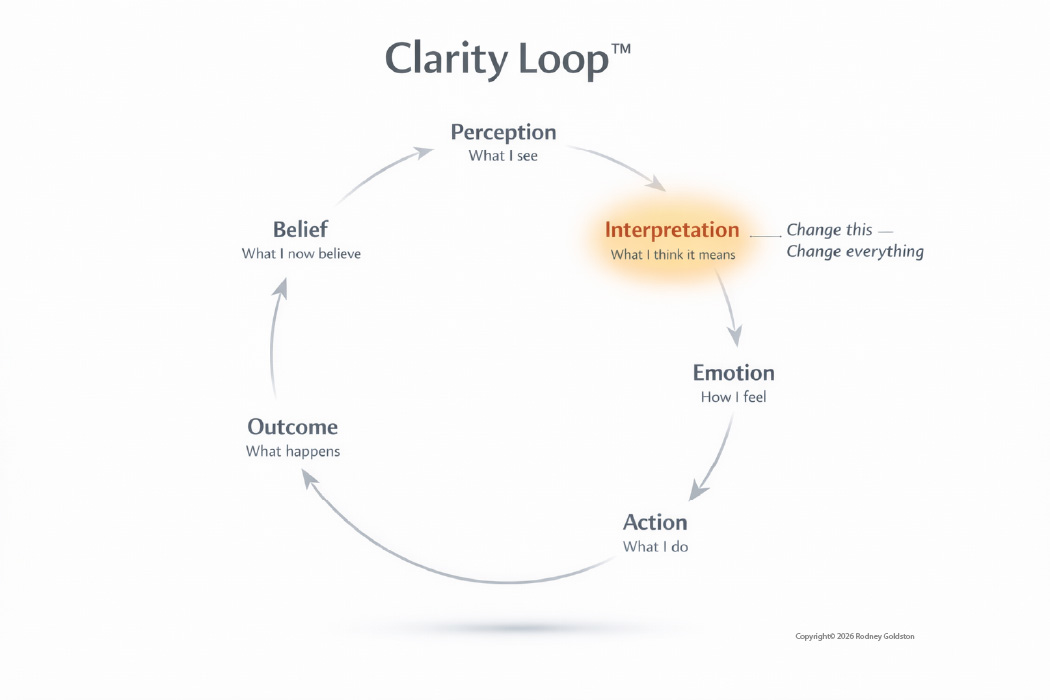
The Clarity Loop™ follows six stages:
Perception → Interpretation → Emotion → Action → Outcome → Belief
The loop is simple enough to remember, but powerful enough to explain why small moments can become major persistence risks.
Perception: What I See
Perception is the student’s immediate experience of reality.
It is what the student sees, hears, notices, receives, or encounters.
A syllabus with unfamiliar language.
A professor moving quickly through material.
A financial aid message that feels technical.
A portal notification with missing context.
A class where other students seem more confident.
An advising process with multiple steps.
A campus office that feels intimidating.
Perception is not yet meaning. It is raw input. But students never stay at raw input for long. The human mind moves quickly to explanation. It asks, “What does this mean?”
That question begins the next stage.
Interpretation: What I Think It Means
Interpretation is the hinge.
This is the moment where the loop can either support persistence or accelerate drift.
Interpretation turns experience into meaning.
A student sees a low grade.
Interpretation says, “I need a better strategy.”
Or interpretation says, “I am not smart enough.”
A student sees a complicated financial aid requirement.
Interpretation says, “I need someone to walk me through this.”
Or interpretation says, “College is designed to make people like me fail.”
A student sees other students speaking confidently in class.
Interpretation says, “They may have more background than I do, but I can learn.”
Or interpretation says, “I am the only one who does not belong.”
This is why interpretation deserves special attention.
Many institutions design interventions around behavior. They ask: Did the student attend? Did the student submit? Did the student register? Did the student respond?
Those questions matter. But they may arrive after the student has already interpreted the situation in a way that reduces action.
The earlier question is:
What is the student believing right now that is shaping the next move?
That question changes the work.
It moves intervention from correction to clarity.
Emotion: How I Feel
Interpretation creates emotion.
A student who interprets difficulty as temporary may feel challenged, frustrated, or stretched, but still capable of continuing.
A student who interprets difficulty as personal failure may feel shame, fear, isolation, embarrassment, or defeat.
This emotional response is not decorative. It affects cognition, motivation, attention, and action.
When students feel capable, they are more likely to ask questions, seek support, revise strategies, and re-enter the work.
When students feel ashamed, they are more likely to hide.
When students feel confused, they may delay.
When students feel afraid, they may avoid.
When students feel alone, they may disconnect.
This is how an academic issue becomes an emotional issue. And once the emotional weight rises, the next action becomes harder.
Not because the student does not care.
Because the emotional cost of re-entry has increased.
Action: What I Do
Action is where institutions often begin to notice the problem.
The student stops attending.
The student does not submit the assignment.
The student avoids the email.
The student misses the appointment.
The student does not register.
The student does not ask for help.
The behavior becomes visible, but the loop started earlier.
By the time the action changes, perception has already been interpreted, emotion has already formed, and the student may already be moving from confusion to avoidance.
This is why action-level interventions can feel frustrating for institutions.
A staff member sends a reminder, but the student does not respond.
A professor offers office hours, but the student does not come.
An advisor says support is available, but the student does not schedule.
The institution may think, “We gave them the opportunity.”
But the student may be trapped in an interpretation that makes using the opportunity feel impossible, embarrassing, or pointless.
At this stage, the student may not need more options first.
They may need a smaller next step.
They may need a human being to reduce the meaning-load of the moment.
They may need someone to say, with specificity and calm authority, “This is recoverable. Here is the next move.”
Outcome: What Happens
Action produces outcome.
If the student avoids the class, they miss more material.
If they ignore the email, the deadline passes.
If they do not ask for help, confusion compounds.
If they delay registration, options narrow.
If they disappear socially, belonging weakens.
The outcome then appears to confirm the student’s interpretation.
“I knew I was behind.”
“I knew I couldn’t do this.”
“I knew nobody would notice.”
“I knew this place was not for me.”
This is one of the cruelest parts of the loop. Avoidance often creates the very evidence that fear predicted.
The student fears they are behind, so they avoid the place where recovery could begin. The avoidance makes them more behind. The outcome then tells them the original fear was true.
This is how temporary difficulty hardens into reinforced belief.
Belief: What I Now Believe
Belief is the residue of repeated outcomes.
One experience may create stress.
Repeated experiences create identity.
A student who repeatedly experiences confusion, avoidance, and negative outcomes may begin to believe:
I am not college material.
I do not belong here.
I always mess things up.
I cannot recover once I fall behind.
Asking for help will expose me.
Nobody really sees me here.
These beliefs then shape future perception.
The next email is not just an email.
It is another threat.
The next assignment is not just an assignment.
It is another test of identity.
The next advising meeting is not just a meeting.
It is another chance to feel exposed.
The loop begins again, but now the student is not starting from neutral. They are starting from a reinforced belief that may already be tilted toward fear, withdrawal, or resignation.
That is why the Clarity Loop™ matters.
It shows how students can become trapped not only by circumstances, but by the meaning those circumstances have accumulated.
The Leverage Point: Interpretation
The most important part of the Clarity Loop™ is interpretation.
Change the interpretation, and the rest of the loop can change.
Self-efficacy research helps explain why this matters. Bandura defined self-efficacy as belief in one’s capacity to organize and execute the actions required to manage situations and achieve outcomes (Bandura, 1977, 1997). In a persistence context, this means belief is not ornamental. It influences whether a student attempts, avoids, persists, or gives up.
This does not mean institutions should ignore real barriers or pretend that every problem can be solved by mindset. Financial pressure, academic preparation, family responsibilities, mental health, institutional complexity, and structural inequities are real. A clarity-based framework should never be used to blame students for struggling inside systems that may be hard to navigate.
But even when the barrier is real, interpretation still matters.
A student who sees a barrier as permanent may withdraw.
A student who sees a barrier as navigable may seek support.
A student who sees confusion as proof of inadequacy may hide.
A student who sees confusion as a signal for clarification may ask.
A student who sees difficulty as disqualification may leave.
A student who sees difficulty as part of transition may continue.
The goal is not to talk students out of reality.
The goal is to help them interpret reality accurately enough to move.
That is the difference between shallow encouragement and strategic clarity.
Shallow encouragement says, “You’ll be fine.”
Strategic clarity says, “You are not fine yet, but this is recoverable. Here is what happened, here is what it means, here is what it does not mean, and here is the next action.”
That kind of clarity lowers the emotional temperature. It reduces uncertainty. It restores agency. It gives the student enough ground beneath their feet to take the next step.
Why More Information Is Not Always More Clarity
Institutions often assume that if students have information, they have clarity.
They do not.
Information is available.
Clarity is usable.
Information can be a webpage, an email, a policy, a portal, a handbook, a form, or a list of services.
Clarity is when the student understands what matters, what it means, what applies to them, and what to do next.
A student can be surrounded by information and still feel lost.
In fact, too much information without interpretation can make the problem worse. It can create noise. It can increase decision fatigue. It can make students feel responsible for navigating a system they do not yet understand.
This is especially important in the first year, when students are not only learning academic content. They are learning institutional language, hidden rules, office names, deadlines, policies, expectations, and consequences.
What feels obvious to the institution may be opaque to the student.
What feels routine to a staff member may feel high-stakes to a first-generation student.
What feels like a simple instruction to a faculty member may feel like a coded message to a student already carrying shame.
That is why clarity is not merely communication.
Clarity is translation.
It turns institutional information into student action.
Applying the Clarity Loop™ to Student Persistence
The Clarity Loop™ gives institutions a practical diagnostic lens.
Instead of asking only, “What did the student do?”
It invites a deeper sequence of questions:
What did the student perceive?
How did the student interpret it?
What emotion did that interpretation produce?
What action followed?
What outcome resulted?
What belief may now be reinforced?
This sequence helps coordinators, advisors, faculty, and student success teams move beyond surface behavior.
For example:
A student misses two classes.
The surface response is attendance correction.
The Clarity Loop™ response asks: What happened before the absence? What did the student think the absence meant? Did shame make returning harder? What would make re-entry feel possible?
A student does not complete a financial aid form.
The surface response is another reminder.
The Clarity Loop™ response asks: Does the student understand the form? Do they know the consequence? Are they overwhelmed by the language? Do they believe asking for help will expose something embarrassing?
A student avoids advising.
The surface response is appointment outreach.
The Clarity Loop™ response asks: What does advising represent to this student? Support? Judgment? Confusion? Another adult telling them what they failed to do?
These questions do not require institutions to become therapists. They require institutions to become better interpreters of student behavior.
The work is not to rescue students from responsibility.
The work is to help students recover the clarity required to act responsibly.
The Clarity Loop™ and the Drift Pattern™
The Clarity Loop™ explains why the Drift Pattern™ develops.
Micro-disengagement often begins when perception is confusing or discouraging.
Narrative formation begins when interpretation assigns meaning to that experience.
Identity shift begins when repeated emotions, actions, and outcomes reinforce the wrong belief.
The exit decision becomes logical when the student’s belief system now supports leaving.
This connection is critical.
The Drift Pattern™ shows the progression.
The Clarity Loop™ shows the mechanism.
Together, they help institutions move from late-stage reaction to early-stage intervention.
The earlier the loop is interrupted, the more likely the student can recover without needing a major crisis response.
Interruption does not always require a large program. Sometimes it requires a timely conversation. A better question. A clearer next step. A reframed moment. A coordinator who listens for interpretation, not just facts.
The practical north star is this:
What is this student believing right now that is shaping their next move?
Shift that, and everything downstream can begin to change.
Clarity Creates Movement
Clarity does not remove all difficulty.
It makes difficulty navigable.
It does not guarantee that every student persists.
It gives students a better chance to act before fear becomes withdrawal.
It does not replace academic support, financial support, advising, mental health resources, or belonging work.
It strengthens the student’s ability to use them.
When students can interpret difficulty without turning it into personal failure, movement becomes possible.
When movement becomes possible, students create new evidence.
When students create new evidence, belief can begin to rebuild.
That is the deeper promise of the Clarity Loop™.
Clarity creates movement.
Movement creates evidence.
Evidence rebuilds belief.
And belief sustains progress.
5. The Initiation Gap™: Why Access Alone Is Not Enough
Higher education has spent decades expanding access to information, resources, and support.
Students can access learning management systems, advising portals, tutoring centers, financial aid offices, counseling services, career services, student success teams, peer mentors, and digital alerts. In many institutions, the support ecosystem is larger than it has ever been.
And still, students drift.
That is the uncomfortable truth.
The presence of support does not guarantee the use of support.
A resource can exist and remain untouched.
A message can be sent and remain unopened.
A policy can be explained and remain misunderstood.
A student can have options and still not act.
This is where The Initiation Gap™ becomes essential.
The Initiation Gap™ is the inability to self-start in an environment that requires self-starting.
It is not primarily a lack of intelligence.
It is not always a lack of ambition.
It is not simply a lack of resources.
It is the gap between what the environment now requires and what the student has been trained, conditioned, or supported to do.
In the first-year experience, this gap often shows up as hesitation.
The student knows something is wrong, but does not know how to begin fixing it.
The student knows help may exist, but does not know which help applies.
The student knows they should reach out, but does not know what to say.
The student knows a decision must be made, but waits until the decision becomes urgent.
The student knows they are slipping, but waits for someone else to notice.
The problem is not always awareness.
Sometimes the problem is initiation.
From Directed Structure to Self-Direction
To understand the Initiation Gap™, institutions must look carefully at the transition students are making.
Many students arrive from environments where the structure was visible, repeated, and enforced.
They were told where to be.
They were told when to move.
They were told what was due.
They were reminded when they missed something.
They were corrected quickly.
They were graded often.
They were surrounded by adults whose job was to notice when they fell out of sequence.
This does not mean K–12 education is easy, simple, or uniform. Students have wildly different experiences depending on school quality, family support, neighborhood context, disability status, economic pressure, and a host of other realities. But structurally, many pre-college environments operate with tighter feedback loops than higher education.
The school day has a rhythm.
The schedule is largely fixed.
The rules are more immediate.
The consequences are often closer to the behavior.
The adult monitoring is more direct.
Then the student enters college.
The rhythm changes.
Time opens up.
Deadlines may be listed once and enforced weeks later.
Attendance may be expected but not chased daily.
Faculty may assume students know how to ask for help.
Advisors may be available, but students must schedule.
Financial aid may have rules, but students must interpret them.
Support may exist, but students must initiate contact.
The institution has not necessarily abandoned the student.
But the burden of initiation has shifted.
And for many students, that shift is larger than anyone names.
The old environment says, “Follow the structure.”
The new environment says, “Create enough structure to keep moving.”
The old environment says, “Wait until called on.”
The new environment says, “Ask before the crisis becomes visible.”
The old environment says, “Complete the next assigned task.”
The new environment says, “Determine the next right move.”
That transition is not merely academic.
It is behavioral.
It is psychological.
It is developmental.
And when it goes unnamed, students can interpret their difficulty initiating as personal failure instead of transitional mismatch.
The Permission-Based Student in a Self-Directed Environment
Many students have been trained by systems that reward compliance more visibly than initiative.
Raise your hand.
Wait your turn.
Stay in line.
Follow the sequence.
Complete the worksheet.
Take the test.
Wait for the grade.
Wait for the adult to tell you what comes next.
These behaviors are not inherently bad. Structure matters. Discipline matters. Sequence matters. Institutions cannot function without order.
The problem emerges when students internalize the structure so deeply that they become dependent on external triggers for action.
They do not move until someone tells them to move.
They do not ask until someone invites the question.
They do not seek help until someone names the danger.
They do not create a plan until someone requires it.
They wait to be chosen by the system.
Then they enter a college environment where success often requires proactive movement before anyone calls their name.
This is the collision.
Students trained in permission-based systems are placed inside self-directed environments and expected to behave as if initiative has already been built.
For some students, it has been.
They arrive with family guidance, school preparation, cultural capital, personal confidence, and prior exposure to institutional navigation. They know how to email a professor. They know how to ask for an exception. They know that office hours are not punishment. They know how to read a syllabus as a planning document. They know how to escalate a question until they find an answer.
Other students arrive with aspiration, but not the same initiation fluency.
They may be capable.
They may be intelligent.
They may be deeply motivated.
But they may not yet know how to self-start inside an institution whose rules are often written in invisible ink.
That is the Initiation Gap™.
When Access Becomes Passive
Access is necessary.
But access can become passive when students do not know how to convert it into action.
A tutoring center is access.
Scheduling the appointment is initiation.
A professor’s office hours are access.
Walking through the door is initiation.
A degree audit is access.
Understanding how to use it to make decisions is initiation.
A financial aid portal is access.
Completing the right step before the deadline is initiation.
An advisor is access.
Preparing questions and asking for guidance is initiation.
A learning management system is access.
Turning the course calendar into a weekly action plan is initiation.
This distinction matters because institutions can overestimate student support by counting what exists, while underestimating the behavioral complexity required to use it.
The student success question cannot only be:
What resources are available?
It must also be:
Can students initiate the behaviors required to benefit from those resources?
That second question exposes a hidden layer of persistence work.
Students do not simply need support.
They need the internal and practical capacity to activate support.
The Emotional Cost of Initiation
Initiation is not just a task.
It can carry emotional weight.
For a confident student, emailing a professor may feel ordinary.
For a drifting student, it may feel like confession.
For a student with institutional fluency, going to office hours may feel strategic.
For a student carrying shame, it may feel like walking into court.
For a student who has been taught to advocate, asking financial aid for clarification may feel normal.
For a student who feels they should already understand, asking may feel exposing.
This is why the Initiation Gap™ connects directly to the Clarity Loop™.
The student does not merely perceive a required action.
They interpret the meaning of taking that action.
If asking for help means “I am responsible,” the student may act.
If asking for help means “I am stupid,” the student may avoid.
If scheduling advising means “I am planning,” the student may move.
If scheduling advising means “I am already behind,” the student may delay.
If using tutoring means “I am using a tool,” the student may engage.
If using tutoring means “I am not smart enough,” the student may disappear.
The action is the same.
The interpretation changes the emotional cost.
And when the emotional cost rises, initiation falls.
This is why telling students, “Just ask for help,” is often insufficient.
To an institution, that sentence may sound empowering.
To a student in shame, it may sound like proof that they have failed to do something obvious.
The better approach is to lower the emotional cost of initiation.
Normalize help-seeking.
Make the first step smaller.
Clarify what the student should say.
Explain what will happen next.
Separate struggle from identity.
Treat support as part of the success path, not a remedial corner for students who have fallen short.
In other words, do not simply offer the door.
Help the student cross the threshold.
The Hidden Curriculum of Self-Starting
Every institution has a hidden curriculum.
Not only the official academic curriculum, but the unwritten rules students must learn in order to succeed.
How to read a syllabus.
How to interpret faculty expectations.
How to manage unstructured time.
How to ask a precise question.
How to recover after falling behind.
How to use office hours.
How to understand degree progress.
How to navigate financial aid.
How to advocate without feeling disrespectful.
How to distinguish a difficult semester from a doomed future.
How to keep moving when no one is standing over your shoulder.
Students who already understand this hidden curriculum may appear more motivated, mature, or prepared.
Students who do not understand it may appear passive, disengaged, or careless.
But the difference may not be character.
It may be exposure.
It may be translation.
It may be clarity.
The Initiation Gap™ helps institutions avoid confusing unfamiliarity with unwillingness.
A student who does not initiate may not be refusing responsibility.
They may not yet know how responsibility works in this new environment.
That distinction matters because it changes the intervention.
If the issue is unwillingness, the institution pushes harder.
If the issue is unclear initiation, the institution teaches the move.
Initiative Can Be Taught
A dangerous assumption sits beneath much of the college transition.
The assumption is that students should already know how to initiate.
Some do.
Many do not.
But initiative is not magic. It is a teachable capacity.
Students can learn to notice drift earlier.
They can learn to ask better questions.
They can learn to convert confusion into action.
They can learn to create weekly plans.
They can learn to identify support before crisis.
They can learn to communicate with faculty and staff.
They can learn to recover after missed deadlines.
They can learn to interpret struggle without turning it into identity failure.
But these capacities must be named, modeled, practiced, and reinforced.
A single orientation session may not be enough.
A resource list may not be enough.
A portal announcement may not be enough.
Students need repeated opportunities to build the muscle of self-direction.
This is where student success work becomes developmental, not merely administrative.
The goal is not to carry students.
The goal is to build their capacity to carry themselves with greater clarity, confidence, and agency.
That is a different kind of support.
It is not rescue.
It is retraining.
The Constraint Is No Longer Only Access
For many students, the central constraint is no longer simply whether information exists.
The constraint is whether they can act on what exists.
This does not mean access problems have been solved. They have not. Cost, transportation, broadband, advising capacity, staffing, housing, food insecurity, and mental health access remain real issues.
But alongside those access issues sits another problem:
The constraint is no longer access alone.
The constraint is initiation.
That line should unsettle institutions in a useful way.
Because it asks leaders to look beyond the resource map and examine the action map.
Where do students need to initiate?
Where are they most likely to hesitate?
Where does institutional language create confusion?
Where does shame increase avoidance?
Where do students wait for permission in a system that expects self-direction?
Where do students need a clearer first move?
Once institutions see these points, they can design better bridges.
Not by lowering standards.
Not by removing responsibility.
But by teaching the behaviors that responsibility now requires.
What the Initiation Gap™ Looks Like in Practice
The Initiation Gap™ often appears in ordinary moments.
A student receives feedback on a paper but does not know how to use it.
They wait.
A student sees a failing grade in the portal but does not email the professor.
They wait.
A student is unsure whether to drop a class, change a major, or seek tutoring.
They wait.
A student knows registration is open but feels overwhelmed by course choices.
They wait.
A student has a financial hold but does not understand the next step.
They wait.
A student feels disconnected from campus but does not join anything because joining itself requires initiation.
They wait.
Waiting becomes the default strategy.
But in higher education, waiting often compounds the problem.
Deadlines pass.
Options narrow.
Confidence erodes.
Shame deepens.
The loop reinforces itself.
The student is not standing still.
They are drifting.
This is why initiation must be treated as a persistence skill.
Not a personality trait.
Not a moral judgment.
A skill.
And if it is a skill, it can be taught, practiced, assessed, supported, and strengthened.
Closing the Initiation Gap™
Closing the Initiation Gap™ requires more than telling students to be proactive.
Proactive behavior must be broken into visible moves.
Instead of saying, “Talk to your professor,” institutions can teach students how to write the first email.
Instead of saying, “Use tutoring,” institutions can explain when tutoring is useful, what happens in the first session, and why strong students use it before they are desperate.
Instead of saying, “Manage your time,” institutions can help students build a weekly academic execution plan.
Instead of saying, “Ask for help,” institutions can normalize the exact moments when help-seeking is wise.
Instead of saying, “Stay engaged,” institutions can define what engagement looks like during a difficult week.
Instead of saying, “You belong here,” institutions can help students create evidence of belonging through action, connection, and progress.
This is how clarity becomes practical.
It turns vague expectations into visible behaviors.
It turns institutional resources into student movement.
It turns confusion into the next right step.
From Waiting to Choosing
At the deepest level, the Initiation Gap™ is about agency.
A student who waits for the institution to choose them may remain passive until the problem becomes severe.
A student who learns to choose themselves begins to move earlier.
They ask.
They schedule.
They clarify.
They recover.
They revise.
They return.
They initiate.
That shift is not merely motivational. It is operational.
It changes how students behave under pressure.
It changes whether they interpret difficulty as a stop sign or a signal.
It changes whether support remains available in theory or becomes useful in practice.
The Initiation Gap™ explains why students can be surrounded by resources and still drift.
The Clarity Loop™ explains why hesitation takes root.
The Drift Pattern™ explains how hesitation becomes departure.
Together, these frameworks point toward a central conclusion:
Persistence is not only about keeping students enrolled.
It is about helping students build the clarity and agency required to keep moving when external structure decreases.
Access opens the door.
Clarity shows the path.
Initiation takes the step.
6. Clarity → Hope → Action: A Better Persistence Lens
If confusion creates fear, clarity creates movement.
That is the heart of this framework.
Students do not need institutions to pretend the path is easy. They need institutions to help make the path understandable enough to move through. Difficulty does not automatically cause disengagement. Students can persist through difficult courses, financial pressure, family demands, long commutes, heavy workloads, and personal uncertainty when they can still see a path forward.
What breaks many students is not difficulty alone.
It is difficulty without clarity.
When the next step disappears, fear fills the empty space.
When the meaning of the struggle becomes distorted, identity begins to bend under the pressure.
When students cannot see how to recover, avoidance can feel safer than action.
That is why persistence work must include a clearer understanding of the emotional pathway beneath student behavior.
The negative pathway is:
Confusion → Fear → Withdrawal
The positive pathway is:
Clarity → Hope → Action
This is not motivational language. It is an operating sequence.
Confusion increases uncertainty. Uncertainty raises emotional threat. Emotional threat increases hesitation. Hesitation reduces action. Reduced action produces outcomes that reinforce fear.
Clarity interrupts that sequence.
Clarity reduces uncertainty. Reduced uncertainty lowers emotional threat. Lower emotional threat makes action feel possible. Action creates evidence. Evidence rebuilds belief.
This is how hope is built.
Not through slogans.
Through usable clarity.
Confusion → Fear → Withdrawal
Confusion is often misunderstood.
Institutions may interpret confusion as lack of attention, lack of preparation, or lack of seriousness. Sometimes those factors may be involved. But confusion itself is not a character flaw. Confusion is a lack of usable structure, signal, or direction.
A student may be confused because expectations are unclear.
They may be confused because institutional language is unfamiliar.
They may be confused because different offices gave them different answers.
They may be confused because they do not know which problem to solve first.
They may be confused because they have never had to manage this much unstructured time.
They may be confused because they are trying to make adult decisions without adult-level institutional fluency.
Confusion does not stay neutral for long.
When confusion persists, the mind starts filling in blanks.
And the mind often fills blanks with threat.
I am behind.
I am exposed.
I am the only one who does not understand.
I am going to lose my aid.
I am disappointing my family.
I am not good enough for this program.
Once confusion becomes fear, students often stop moving toward the problem. They move away from it.
They do not open the email.
They do not check the gradebook.
They do not attend the class where they feel behind.
They do not ask the professor the question.
They do not go to the office where the issue could be clarified.
They do not tell anyone how bad it feels.
Withdrawal often looks like indifference from the outside.
Inside, it may be self-protection.
A student who is ashamed may avoid the very person who can help.
A student who is afraid may delay the very action that would reduce fear.
A student who feels lost may choose silence because silence feels less risky than being seen struggling.
This is why institutions should be careful about interpreting withdrawal too quickly.
What looks like apathy may be fear wearing a mask.
What looks like irresponsibility may be confusion that was never translated.
What looks like disengagement may be a student slowly disconnecting from their own sense of control.
Clarity → Hope → Action
Clarity is not merely information.
Information tells students what exists.
Clarity helps students understand what matters, what it means, what applies to them, and what to do next.
Information says, “Tutoring is available.”
Clarity says, “Because you scored below 70 on the first exam, schedule tutoring this week. Bring your exam, the syllabus, and two questions. The goal of the first session is not to prove you are behind. The goal is to build a recovery plan.”
Information says, “Meet with your advisor.”
Clarity says, “You need to meet with your advisor before registration because your next course depends on this prerequisite. Ask these three questions during the meeting.”
Information says, “Check your financial aid portal.”
Clarity says, “There is one missing document. If you upload it by Friday, your aid review can continue. If you do not, your balance may remain unresolved.”
Information says, “You belong here.”
Clarity says, “Struggling in the first semester is not evidence that you do not belong. It is evidence that the transition is demanding. Here are the three moves students make when they recover.”
Clarity turns the lights on.
And when the path becomes visible, hope rises.
Hope is not hype.
Hope is the emotional result of seeing a possible path.
A student does not need to believe everything will be easy. They need to believe the next step is possible, meaningful, and worth taking.
Hope says:
Maybe this is recoverable.
Maybe I am not as far gone as I thought.
Maybe I can ask without being judged.
Maybe I can still pass.
Maybe I can still belong.
Maybe I can take one step today.
That is enough.
Hope does not need to solve the whole semester at once. Sometimes it only needs to make the next move visible.
Once hope returns, action becomes more likely.
The student replies.
The student schedules.
The student attends.
The student asks.
The student submits.
The student revises.
The student returns.
That action creates new evidence. New evidence can rebuild belief. And rebuilt belief strengthens persistence.
This is the positive loop institutions should be designing for.
Clarity Is a Retention Strategy
Retention strategies often focus on systems, policies, dashboards, outreach protocols, advising models, early alerts, and academic support. These are necessary. But they become more powerful when they are organized around clarity.
Clarity is what helps students convert support into action.
A student who does not understand the alert may ignore it.
A student who understands the alert and the next step may respond.
A student who receives a generic message may feel unseen.
A student who receives a clear, specific, timely message may feel guided.
A student who is told to improve may feel judged.
A student who is shown how to recover may feel capable.
This is why clarity should not be treated as a communication preference. It should be treated as a retention strategy.
The question is not only, “Did we communicate?”
The question is, “Did we create usable clarity?”
Usable clarity has several qualities.
It is specific.
It is timely.
It reduces ambiguity.
It names the next step.
It explains why the step matters.
It lowers unnecessary shame.
It connects the student back to agency.
It gives enough structure for movement without removing responsibility.
This kind of clarity does not infantilize students. It equips them.
It does not lower expectations. It makes expectations navigable.
It does not replace accountability. It makes accountable action more possible.
The Difference Between Rescue and Restoration
A clarity-based persistence model must be careful not to become rescue culture.
The goal is not to chase students forever, excuse every missed responsibility, or remove every consequence. That approach can create dependency and exhaust institutional staff.
The goal is restoration of agency.
Rescue says, “We will carry you.”
Restoration says, “We will help you see clearly enough to move.”
Rescue removes responsibility.
Restoration makes responsibility understandable and actionable.
Rescue centers the institution as savior.
Restoration centers the student as capable.
This distinction matters because many student success professionals already carry heavy emotional and operational loads. A clarity-based model should not ask them to become superheroes. It should give them a sharper way to intervene.
The role of the guide is not to solve the student’s entire life.
The role of the guide is to help the student interpret the moment accurately, identify the next move, and reconnect to agency.
That may mean asking:
What are you believing right now about what happened?
What part of this feels unclear?
What is the next decision you need to make?
What is the smallest recoverable step?
Who needs to hear from you before Friday?
What would make this feel less overwhelming?
What does this situation mean, and what does it not mean?
These questions do not remove responsibility. They organize it.
They help students move from emotional fog to practical direction.
Hope Requires Evidence
Hope cannot survive forever on words alone.
At some point, the student needs evidence.
A completed assignment.
A professor who replies.
A tutoring session that helps.
A financial aid question answered.
A registration issue resolved.
A difficult conversation survived.
A week planned and completed.
A small win.
A returned sense of control.
This is why action matters.
Clarity creates hope, but action gives hope something to stand on.
Without action, hope remains fragile. With action, hope begins to gain weight. It becomes embodied. It becomes credible.
Students begin to think:
I did that.
I asked.
I recovered.
I understood.
I showed up.
I handled it.
That evidence becomes fuel for the next action.
This is how the Self-Efficacy Loop begins to rebuild:
Action → small wins → belief → bigger action
This aligns with Bandura’s central insight that efficacy beliefs influence human agency, including the actions people choose, the effort they invest, and their persistence when difficulties appear (Bandura, 1977, 1997).
When that loop is broken, momentum dies.
When that loop is restored, persistence has something to grow from.
Institutions should therefore design for early evidence. Not just final outcomes. Not just end-of-semester success. Early evidence.
Students need proof that movement works.
They need to see that a conversation can reduce confusion, that a plan can lower stress, that a resource can help, that a missed step can be recovered, that difficulty is not the same as doom.
This is how clarity becomes hope.
And how hope becomes action.
Designing for the Next Right Step
One of the most practical uses of the Clarity → Hope → Action pathway is the discipline of designing the next right step.
Students in fear do not need ten options.
They often need one clear move.
Too many options can increase paralysis. A long list of resources may be accurate, but accuracy alone may not create movement. When students are overwhelmed, the institution should help them identify the next right step.
Not the whole life plan.
Not the entire academic journey.
The next right step.
Send this email.
Attend this session.
Bring this document.
Ask this question.
Complete this form.
Study this chapter first.
Go to this office before Wednesday.
Meet this person at this time.
Return to class tomorrow even if you feel embarrassed.
This is where clarity becomes practical, not poetic.
The next right step gives the student traction.
And traction matters because drifting students do not need a speech about the mountain. They need a foothold.
Once they have a foothold, they can climb.
The Institutional Shift: From Information Delivery to Clarity Design
Many institutions are built for information delivery.
They send emails.
They host orientations.
They publish policies.
They maintain webpages.
They list resources.
They create portals.
All of this matters. But a clarity-based persistence model asks institutions to move from information delivery to clarity design.
Clarity design asks:
Where are students most likely to misinterpret difficulty?
Where does institutional language create unnecessary confusion?
Where do students receive too much information without enough sequence?
Where do students need a human explanation, not just a digital notice?
Where does shame prevent action?
Where can we make the first move smaller and more visible?
Where can we normalize help-seeking before crisis?
Where can we help students build evidence that recovery is possible?
This is not about making college effortless. It is about making the path legible.
A legible path still requires effort.
But the student can see where to place their feet.
The Coordinator as Clarity Guide
In a clarity-based model, student success coordinators, advisors, faculty, mentors, and program staff become more than resource connectors.
They become clarity guides.
A clarity guide listens for the meaning beneath the facts.
The student says, “I missed class.”
The clarity guide listens for, “I am embarrassed to go back.”
The student says, “I don’t know what happened with my aid.”
The clarity guide listens for, “I am afraid I cannot afford to stay.”
The student says, “This major might not be for me.”
The clarity guide listens for, “I am interpreting struggle as a sign of misfit.”
The student says, “I’m good.”
The clarity guide listens for whether “I’m good” means stable, guarded, ashamed, overwhelmed, or already halfway gone.
This kind of listening is not soft.
It is strategic.
Because the person who can hear interpretation can often intervene before the behavior becomes permanent.
A clarity guide does not merely ask, “What happened?”
A clarity guide asks, “What are you making that mean?”
That question can open the door to everything.
A Better Persistence Lens
Clarity → Hope → Action gives institutions a better persistence lens because it helps explain why students with potential still disengage.
It does not deny external barriers.
It does not blame students for systemic complexity.
It does not reduce persistence to positive thinking.
It names the human sequence that often determines whether students move forward or withdraw when pressure rises.
Confusion creates fear.
Fear creates withdrawal.
Clarity creates hope.
Hope creates action.
Action creates evidence.
Evidence rebuilds belief.
Belief sustains progress.
That sequence gives institutions a practical way to think, train, design, and intervene.
It also points to a deeper truth:
Students are not machines that persist because an institution sends the right signal.
Students are meaning-making human beings.
They persist when they can see enough, believe enough, and move enough to stay connected to the future they came to build.
That is why clarity matters.
Because when the path becomes visible, hope has somewhere to stand.
And when hope has somewhere to stand, students can move.
References and Research Anchors
Aguilar Padilla, E., et al. (2025). Why Did They Leave? Learning From the Experiences of Former Community College Students. Community College Research Center, Teachers College, Columbia University.
Bandura, A. (1977). Self-efficacy: Toward a unifying theory of behavioral change. Psychological Review, 84(2), 191–215.
Bandura, A. (1997). Self-Efficacy: The Exercise of Control. W. H. Freeman.
National Student Clearinghouse Research Center. (2025). Persistence and Retention Report Series.
Walton, G. M., & Cohen, G. L. (2011). A brief social-belonging intervention improves academic and health outcomes of minority students. Science, 331(6023), 1447–1451.
 *I will never share, rent, or sell your email address to anyone.