
Clarity Builds Hope™
Clarity reduces fear.
Hope rises when people can see a path again.
Clarity Builds Hope™ is a behavioral and cognitive framework that explains why people often do not disengage because they lack ambition, intelligence, or potential. They disengage because their interpretation of reality breaks down.
Clarity Builds Hope™ sits at the intersection of student persistence research and cognitive science—explaining how interpretation shapes action.
Clarity transforms.
What this framework explainsWhy human beings often stop moving long before they officially quit.
The central ideaAction is shaped not by information alone, but by interpretation.
The practical implicationIf you want better outcomes, you must interrupt breakdowns in interpretation before they harden into withdrawal.
Definition
What Clarity Builds Hope™ means
Clarity Builds Hope™ is a framework for understanding how perception, interpretation, identity, and action work together to shape human behavior.
- Clarity is alignment between what a person sees, what they believe it means, and how they respond.
- Hope is not mere optimism. It is a functional state that emerges when a person can see a viable path forward.
- Action becomes possible when uncertainty is reduced and agency is restored.
Core Claim
People do not always stop because they are incapable.
Many stop because they misread what they are experiencing, lose confidence in what is possible, and slowly disconnect from their own power to move.
Not just an information problem
People can be surrounded by resources and still feel lost.
Not just a motivation problem
What looks like apathy is often distorted interpretation.
The root problem is drift, not deficiency
1
Internal Noise
Overthinking, self-doubt, fear loops, and mental clutter distort perception.
2
Misreading Reality
Temporary struggle gets interpreted as permanent failure or personal inadequacy.
3
Loss of Agency
People stop choosing and start waiting, retreating, or quietly checking out.
The Clarity Loop
Human behavior follows a repeatable sequence. When interpretation is distorted, everything downstream starts bending in the wrong direction.
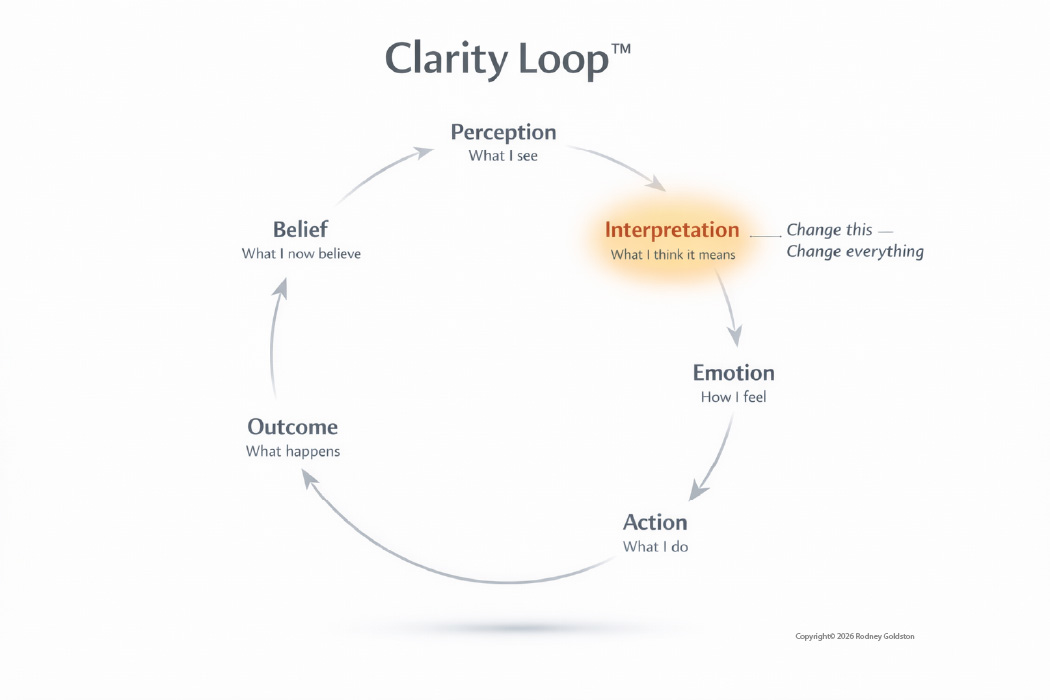
The work is not to fix behavior first. The work is to interrupt the loop at interpretation.
The two pathways
Foundations
Where this perspective comes from
Clarity Builds Hope™ sits at the intersection of student persistence research and cognitive science, explaining how interpretation shapes action.
Research on student persistence has shown that people do not disengage simply because of ability or access, but because of how they experience and interpret their environment, whether they feel they belong, whether their effort feels meaningful, and whether progress feels possible.
Cognitive and behavioral science adds another layer: people act not on reality itself, but on their interpretation of it. When that interpretation becomes unclear, uncertainty rises, confidence drops, and action slows.
This framework brings those insights together into a practical model, one that helps explain why disengagement happens and where meaningful intervention is possible.
Pathway One
Clarity → Hope → Action
Pathway Two
Confusion → Fear → Withdrawal
Pre-Exit Pattern
The drift pattern before people leave
Withdrawal rarely starts at the moment of exit. It usually begins much earlier, internally, quietly, and in stages. :contentReference[oaicite:2]{index=2}
Micro-Disengagement
Small hesitations, missed actions, reduced participation, and quiet withdrawal.
Narrative Formation
People begin telling themselves stories like, “Maybe this isn’t for me.”
Identity Shift
They begin to see themselves as someone who does not belong or cannot succeed.
Exit Decision
Leaving starts to feel rational, even inevitable.
Higher Education Evidence
Why this matters for student persistence
High aspiration at entry
Most students begin with real goals. In the CCRC report, many entered college with high expectations and strong educational ambitions. :contentReference[oaicite:3]{index=3}
Departure is multi-factor
Students rarely leave for one single reason. Most departures are shaped by multiple interacting pressures. :contentReference[oaicite:4]{index=4}
Confidence erodes over time
Students often begin hopeful, then experience stress, self-doubt, weak connection, and interpretation breakdown. :contentReference[oaicite:5]{index=5}
Institutions can make opportunity visible and still fail to make it believable.
Connected Framework
The Visibility–Reality Gap
The Visibility–Reality Gap explains what happens when institutions make opportunity, support, and pathways visible, but those same things are not experienced as believable or reachable.
In other words, the message is present, but the meaning does not land.
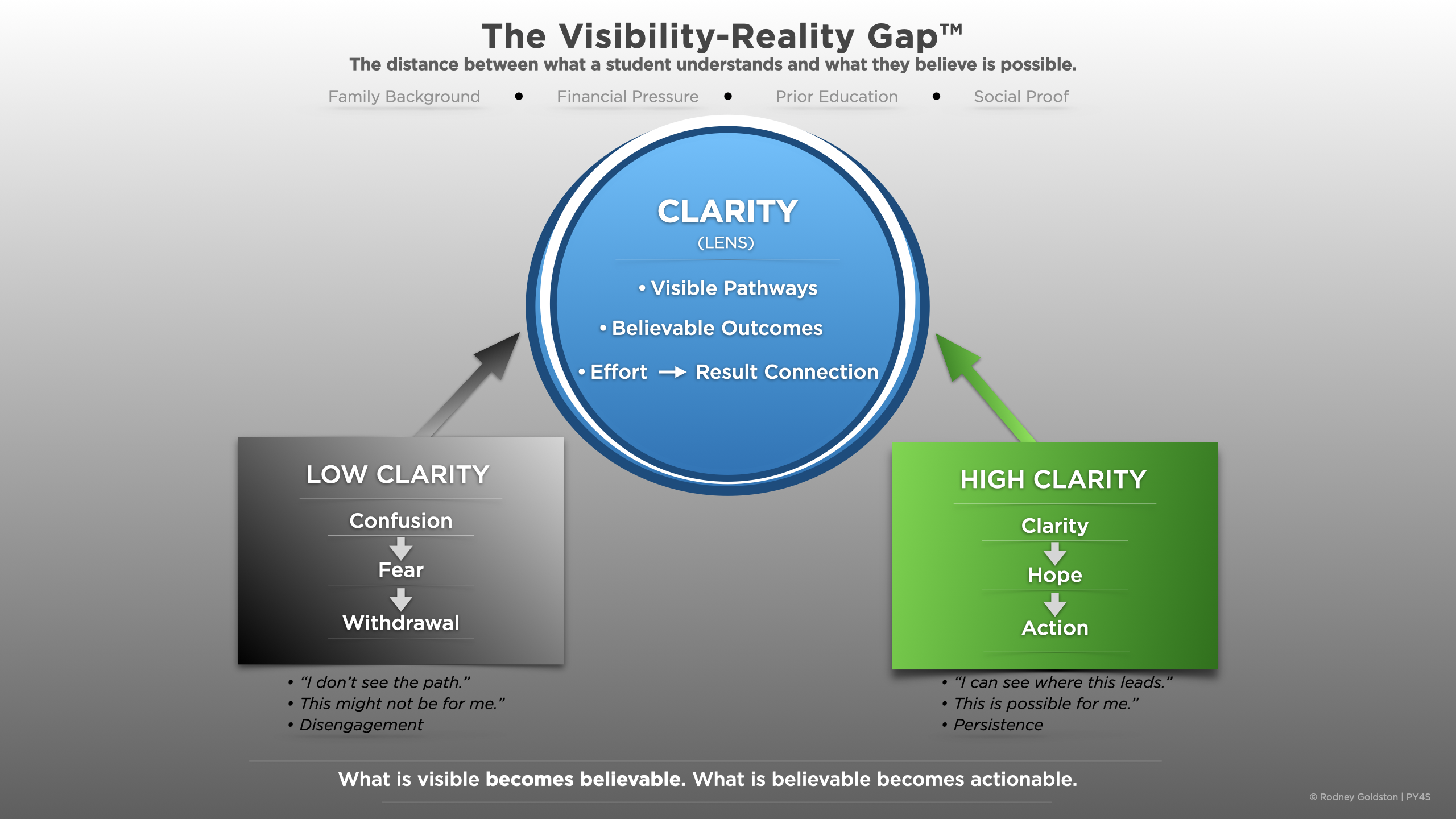
What this looks like in real life
- Support exists, but students don’t experience it as meant for them
- Resources exist, but navigation feels overwhelming
- Opportunities exist, but outcomes don’t feel believable
- Encouragement exists, but internal narratives override it
Intervention Principle
Identity matters more than instructions
Lasting change rarely comes from telling people what to do. It comes from changing how they see themselves, how they interpret difficulty, and what they believe is still possible. :contentReference[oaicite:6]{index=6}
Behavior follows identity. Instructions without identity shift often create temporary compliance, not durable progress.
Language as Leverage
The right words can restore movement
- From “I’m failing” to “I haven’t figured this out yet”
- From “This isn’t for me” to “This is unfamiliar”
- From “I’m behind” to “I need a clearer next step”
Language is not decoration. It is a tool for cognitive realignment. :contentReference[oaicite:7]{index=7}
Coordinator / Advisor / Leader Mindset
The role is not to rescue. The role is to restore clarity.
Notice what others miss
Listen for breakdowns in interpretation, not just bad outcomes.
Challenge narratives carefully
Do not dismiss experience. Reframe it without erasing it.
Reconnect agency
Help people see clearly enough to move themselves again. :contentReference[oaicite:8]{index=8}
Institutional Application
Four areas where clarity can improve persistence
Financial Clarity
Students need more than a price. They need a believable understanding of cost, aid, tradeoffs, and pathway. The CCRC report highlights financial hardship as one of the most commonly cited reasons students leave. :contentReference[oaicite:9]{index=9}
Academic Confidence
Students need early wins, visible progress, and support that strengthens self-efficacy before stress becomes identity.
Human Connection
Students need to feel known, guided, and supported in ways that are specific enough to interrupt isolation and withdrawal.
Guided Decision-Making
Students also need sustained help making sense of majors, pathways, goals, and next steps. When interpretation breaks down, confusion starts masquerading as a final decision.
!– Trying to add Understanding the problem after this –>
At any moment, the most important question is this: what is this person believing right now that is shaping their next move?
The solution is not more information. It’s structured clarity.
If students are disengaging, hesitating, or quietly drifting, the issue is not always effort or ability. It is often a breakdown in how they are interpreting what they are experiencing.
The Pick Yourself Persistence Lab was designed to address that breakdown directly—by helping students rebuild clarity, strengthen interpretation, and reconnect with their ability to move forward.
From concept to application
Clarity Builds Hope™ explains why students disengage. The Persistence Lab shows how to intervene before withdrawal becomes exit.
Designed for institutions
Built for higher education environments, with structured delivery, measurable outcomes, and integration into existing student success efforts.
Focused on real behavior change
Not motivation. Not inspiration. A system for helping students think more clearly, decide more effectively, and act with greater confidence.