The forgotten history of Black political power, the movement that helped dismantle it, and the danger of mistaking a breakthrough for permanent progress.
On November 3, 2026, America made history. Again.
Georgia elected Keisha Lance Bottoms, the first Black woman elected governor of a U.S. state. Texas elected its first Latina governor, Gina Hinojosa. New Mexico elected Deb Haaland, the nation’s first Native American woman governor. And Florida elected Republican Byron Donalds, its first Black governor.
Different candidates. Different political constituencies. Historic achievements worthy of celebration.
Reuters reported on the election’s historic breakthroughs, highlighting the growing representation of Americans long excluded from positions of political power.
But I’ve been thinking about something that makes these celebrations more complicated.
A historic first tells us two stories.
One concerns the extraordinary individual who finally broke through. The other concerns generations of people who may have possessed the same capacity to lead but were never allowed near the starting line.
We celebrate the achievement. Understandably.
But there’s something unsettling about a country congratulating itself on discovering talent that may have been standing in front of it for centuries.
And American history contains an even more uncomfortable truth.
Sometimes the people we’ve spent so long waiting to see in positions of power have already been there.
Reconstruction: When Black Americans Already Held Political Power
Most Americans encounter racial progress as a story of gradual advancement. Slavery gives way to emancipation. Segregation eventually yields to civil rights. Exclusion slowly becomes inclusion.
Reconstruction complicates that familiar narrative.
Following the Civil War, the Thirteenth, Fourteenth, and Fifteenth Amendments transformed American citizenship and political rights. The Fifteenth Amendment, ratified in 1870, prohibited denying voting rights because of race, color, or previous enslavement.
What followed was extraordinary.
According to the U.S. House of Representatives’ historical records, approximately 2,000 Black men held local, state, and federal offices across the South by 1877.
In South Carolina, Black legislators held a majority in the state House of Representatives during Reconstruction.
Think about that.
Just years after slavery, Black Americans were helping govern a Southern state.
They were writing legislation, shaping public education, influencing public spending, and participating in decisions affecting their fellow citizens.
Consider Robert Smalls.
Born enslaved in South Carolina, Smalls escaped during the Civil War by commandeering a Confederate steamship. He later served in the South Carolina legislature and the United States Congress.
A man once legally classified as property became a lawmaker in the country that had enslaved him.
His story was extraordinary, but he wasn’t alone.
Reconstruction demonstrated something that our conventional understanding of American progress often overlooks.
Black Americans weren’t waiting for the twentieth or twenty-first century to demonstrate their capacity to govern.
They had already done so.
How America dismantled its own progress
Reconstruction didn’t simply disappear because Americans grew tired of racial equality.
Its achievements were systematically attacked.
White supremacist organizations, including the Ku Klux Klan, used violence, murder, and intimidation to suppress Black political participation. White Southern Democrats worked to regain control of state governments, while the withdrawal of federal protection in 1877 left Black citizens increasingly vulnerable.
The political coalitions of the nineteenth century differed substantially from today’s parties, but the historical record of who organized much of this resistance is clear.
Then came poll taxes, literacy tests, discriminatory state constitutions, and electoral manipulation.
The results were devastating.
According to the U.S. House’s historical account, Louisiana had approximately 130,000 registered Black voters in 1896.
By 1904, that number had fallen to little more than 1,300.
In 1901, when Representative George Henry White of North Carolina left Congress, Black representation disappeared entirely.
For nearly three decades, not one Black American served in Congress.
Not until Oscar De Priest’s election from Chicago in 1928 did that absence begin to end.
The capacity to govern hadn’t disappeared.
The institutions and protections that made political participation possible had been dismantled.
Progress, it turns out, doesn’t necessarily move in one direction.
A nation can establish rights, recognize political power, and then spend generations destroying what it previously created.
Iowa, 1988: Jesse Jackson, Knee-Deep Snow, and a Pair of Old Nikes
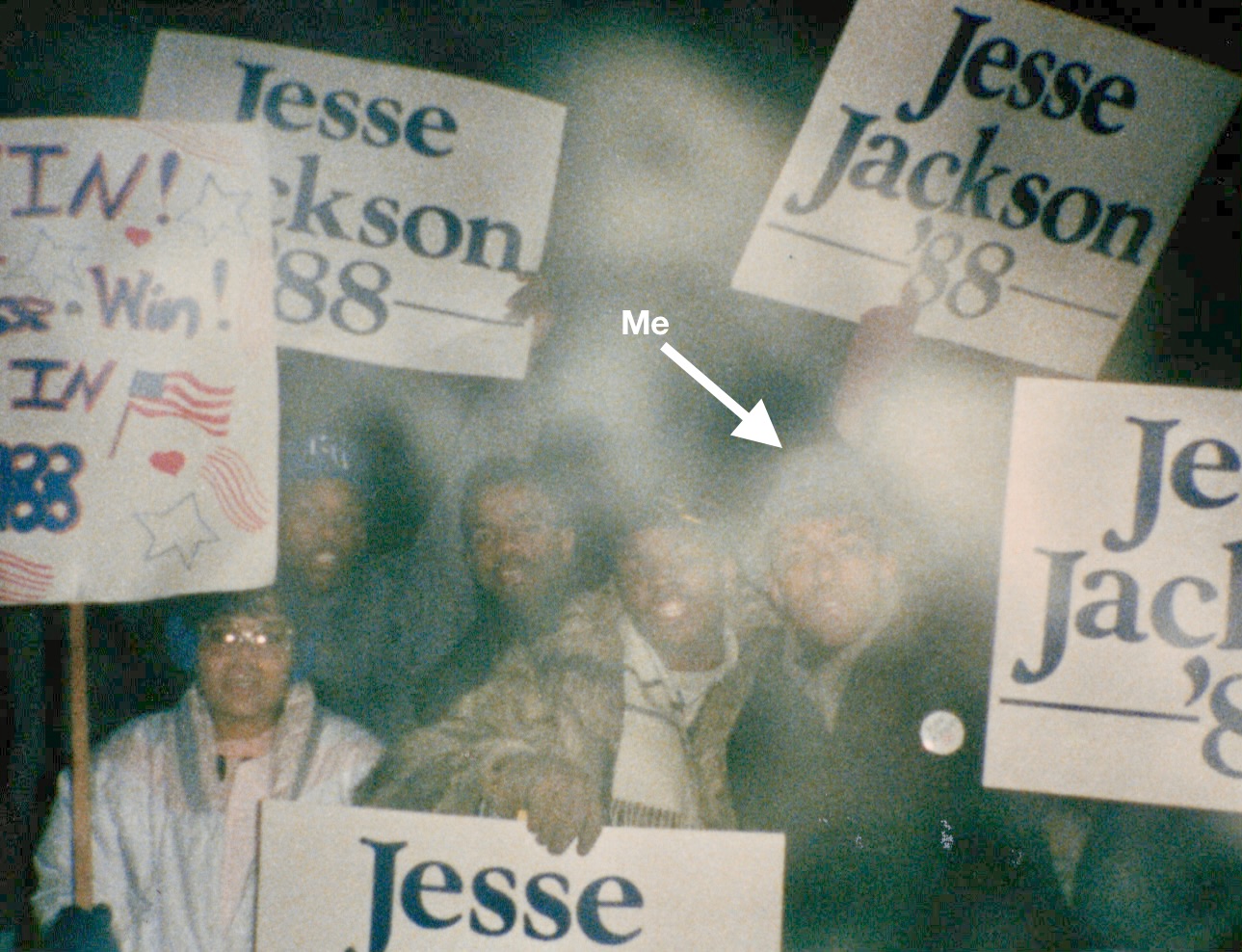
This photo is from the 1988 Iowa caucuses.
I’m standing among supporters of Jesse Jackson’s presidential campaign. At the time, I served as Pennsylvania Assistant State Youth Coordinator.
I had led a busload of college students from Cheyney University to Iowa to distribute campaign flyers.
It was winter. And it was cold.
We trekked through snow that sometimes reached our knees. Many of us came from poor families and didn’t have proper winter boots.
I wore an old pair of Nike running shoes.
Nearly forty years later, I can still remember how cold my feet were.
We stayed at the home of a white family. A few of us slept on the floor beside a burning fireplace.
I remember that fireplace because it was the first real one I’d ever seen or felt.
Back in the hood, we had another way of gathering around a fire. We’d throw wood into big metal trash cans, stand around the flames, and sing “My Girl” by the Temptations.
Now here I was, a young Black man from Pennsylvania, sleeping beside a fireplace in a white family’s home in Iowa, helping a Black presidential candidate build support across racial and economic boundaries.
I didn’t have much money. I didn’t have boots. But I was participating in something I believed mattered.
That memory has stayed with me.
What Jesse Jackson’s Rainbow Coalition represented
Jackson’s Rainbow Coalition was an ambitious attempt to unite people whom American political life had often encouraged to see themselves as belonging to separate worlds.
Black Americans. White working-class voters. Farmers. Labor unions. Latinos. Young people.
People whose experiences differed enormously but whose economic and political interests sometimes overlapped.
A white family’s hospitality didn’t mean America had overcome its racial divisions. But it offered a small, human glimpse of the cooperation Jackson was trying to build.
And his campaign challenged conventional assumptions about who could become a serious presidential contender.
According to PBS FRONTLINE, Jackson received roughly seven million votes during the 1988 primaries and caucuses, including more than two million from white voters.
He won contests in 13 states and finished second in the race for the Democratic presidential nomination.
He didn’t win the nomination.
But his campaign expanded the boundaries of what Americans considered politically possible.
Following Jackson’s death on February 17, 2026, I’ve thought more about that campaign and the young people who participated in it.
We weren’t simply watching history unfold.
We were walking through snow, passing out flyers, and asking people to imagine a different future.
Fear of a Black Planet: What Has America Really Feared?
In 1990, Public Enemy released Fear of a Black Planet, an album confronting racial identity, prejudice, cultural representation, and anxieties about interracial relationships.
Its title also invites a broader question about American political history.
What, exactly, has America feared about Black leadership?
Reconstruction suggests that the resistance involved more than racial prejudice alone.
Political power determines who writes laws, controls public resources, shapes institutions, and decides whose interests government will protect.
There is a profound difference between accepting another group’s presence and accepting its authority.
Black political participation during Reconstruction threatened an established distribution of power. Organized interests responded with intimidation, discriminatory laws, and violence.
We cannot know the private motivations of everyone who resisted racial equality. But the historical behavior is documented.
Black Americans gained influence. Powerful interests organized to restrict it. And when federal protections weakened, much of that influence was taken away.
The country had demonstrated that Black Americans could govern.
The backlash demonstrated how fiercely some people resisted sharing political authority.
The First Makes Headlines. What About the Tenth?
We love celebrating firsts.
The first Black governor. The first woman to lead an institution. The first person from an excluded community to occupy a position of authority.
And we should recognize those achievements.
But the first also reveals something about the barriers that made the achievement exceptional.
The first makes headlines.
The second raises expectations.
The tenth may tell us whether something fundamental has changed.
One exceptional person breaking through a barrier doesn’t prove the barrier has been removed.
Reconstruction offers an even more troubling lesson: a barrier can be crossed, opened more widely, and subsequently rebuilt.
That distinction matters beyond electoral politics.
Consider a university celebrating its first Black president. A corporation announcing its first Black woman CEO. Or a board congratulating itself on a milestone appointment.
Those achievements may be genuine. The individuals may be extraordinarily qualified.
But what happens to the hiring practices, selection processes, informal networks, and assumptions that shaped who was considered leadership material in the first place?
How much talent remains invisible because it doesn’t resemble the people who have traditionally held authority?
Contemporary workplace practices are not equivalent to the racial terrorism and disenfranchisement of Reconstruction. The historical circumstances and consequences differ profoundly.
Still, both invite us to examine the relationship between individual capability and institutional access.
Much of my work through Pick Yourself For Success examines the distance between human potential and human performance.
We often search for explanations inside the individual: fear, self-doubt, hesitation, or an unwillingness to act.
Those barriers are real.
But sometimes a person possesses the talent, courage, discipline, and willingness to lead while the surrounding institutions deny that person meaningful opportunity.
Personal agency matters enormously.
So do the conditions in which that agency must operate.
A serious commitment to human flourishing requires us to examine both.
The Real Measure of American Progress
Keisha Lance Bottoms deserves recognition for her historic victory.
So do the other candidates who crossed barriers in November 2026.
Their achievements say something important about America’s evolving understanding of leadership.
But Reconstruction reminds us that political possibility and political permanence are very different things.
I keep returning to that photograph from Iowa.
A busload of students. Knee-deep snow. Old running shoes. A white family opening its home. Young people working to create a political future they couldn’t yet see.
There was something hopeful about that coalition because it required people to act beyond the boundaries they had inherited.
Yet history teaches us that even extraordinary political breakthroughs can be reversed.
The first deserves a celebration.
The harder work belongs to those who come afterward.
Because a society hasn’t fully transformed when one exceptional individual manages to overcome its barriers.
The deeper transformation comes when capable people no longer have to be exceptional merely to receive the opportunities their predecessors were denied.
Perhaps the day we should celebrate most is the day a Black woman wins a governorship and no one finds her race or gender historically remarkable.
They simply examine her qualifications, her ideas, and her record.
Then decide whether she deserves the job.
Until that day, every historic first should give us two reasons to pay attention.
One for the person who finally broke through.
And another for the history that made the breakthrough necessary.
You can read a version of this over on called Fear of a Black Planet: The Trouble With Celebrating Firsts