Why One Thing You’ve Been Taught About Failure and Success Might Be Wrong
We’ve all heard it: “Your setback is a setup for a comeback.”
It’s the kind of reassurance we offer someone who’s been laid off, whose business is struggling, or whose carefully constructed plans have fallen apart.
And sometimes, it’s true.
But there’s something troubling about that promise. It assumes knowledge of a future that hasn’t happened yet.
When we’re trying to overcome setbacks in life or deal with failure at work, how do we know whether to keep going, change direction, or reconsider the goal altogether?
The answer begins with something we often overlook in stories about success.
The Problem With Looking Backward at Success
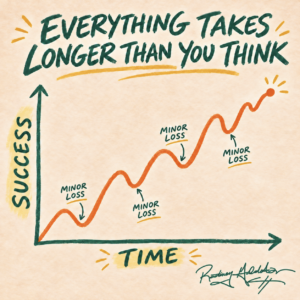
Consider the graph below.
Imagine it represents the journey of someone who has already achieved success. We’re looking backward at the path they traveled, from where they began to where they eventually arrived.
Along the way, the line rises, falls, and rises again. Each downward movement is conveniently labeled “Minor Loss.”
At first glance, it’s reassuring. Even successful people experience setbacks. They stumble, recover, and continue climbing.
But look more closely.
We’re viewing those setbacks through the eyes of someone who already knows the outcome.
We know the losses were temporary because we can see the recovery. We know the story ends in success because the graph shows us the ending.
But the person actually experiencing those setbacks didn’t have that information.
Standing at the bottom of the second dip, that person faces a decision we don’t have to make. Should they keep going or reconsider their approach?
We can see that the line rises again. They can’t.
What looks like a minor loss in hindsight might have looked like a major crisis in real time.
In 1975, psychologist Baruch Fischhoff demonstrated how knowing an event’s outcome can change our judgment of how predictable it was. His research helped establish what psychologists call hindsight bias.
Once we know what happened, it becomes difficult to appreciate how uncertain the situation originally was.
Research: Fischhoff, Hindsight ≠ Foresight, 1975.
Think about how we tell success stories.
We celebrate entrepreneurs who persevered through disappointment. We applaud professionals who rebuilt their careers after devastating setbacks.
But we usually meet these people after the comeback.
We hear far less about those who persevered just as fiercely and never reached the outcome they wanted.
The danger is confusing a successful ending with evidence that every decision along the way was wise.
So what do we do when progress stalls and the ending remains unwritten?
I’ve wrestled with that question through professional setbacks, cancer, and financial disruption. I’ve also learned that perseverance, while valuable, isn’t always sufficient.
How to Overcome Setbacks in Life and at Work: Five Questions Worth Asking
1. Are You Measuring Progress Against Reality or an Imaginary Deadline?
You thought your business would become profitable in a year. Three years later, you’re struggling.
You expected a career transition to take six months. Eighteen months have passed.
You begin questioning your abilities when the problem may be the schedule you imagined.
Psychologists Roger Buehler, Dale Griffin, and Michael Ross examined this tendency in their research on the planning fallacy. They found that people frequently underestimated how long tasks would take, partly because they focused on intended plans rather than relevant past experiences.
Research: Exploring the Planning Fallacy, 1994.
A delayed result deserves investigation. But delay alone doesn’t establish failure.
What to do: Revisit the assumptions behind your original timeline. Compare them with actual conditions, relevant experience, and measurable progress.
Sometimes the goal remains viable. Your timetable simply wasn’t.
2. Do You Know Where You Are, or Just Where You Want to Go?
In my book, Pick Yourself For Success, I share an experience from my service in the United States Army.
I struggled with land navigation.
During training exercises, I was expected to use a map, protractor, compass, and pencil to navigate to a designated destination.
I kept getting lost.
Eventually, a Special Forces soldier helped me understand what I was missing.
He taught me to recognize hills, depressions, bodies of water, and other features of the landscape. I learned to establish my position and determine an azimuth, the direction I needed to travel.
That experience taught me something I’ve never forgotten.
You can be moving continuously and still be moving in the wrong direction.
The same principle applies to business, careers, leadership, and personal development.
What to do: Assess your actual position before investing more effort. What resources remain? What obstacles have emerged? What has changed since you developed your plan?
A destination tells you where you want to go. Understanding the terrain helps you determine how to get there.
3. Are You Experiencing a Temporary Dip or a Dead End?
In his book The Dip, Seth Godin distinguishes between difficult stretches that may lead to worthwhile results and situations in which continued effort offers little meaningful progress.
He calls the latter a Cul-de-Sac.
The distinction matters because both can feel remarkably similar while you’re experiencing them.
A temporary Dip may require patience, new skills, or a different approach. A dead end may require redirecting your resources.
In the chapter “Gettn’ Gritty Wit’ It” from Pick Yourself For Success, I acknowledge occasions when I abandoned challenges simply because they became difficult.
I’ve had to confront that tendency.
But perseverance becomes more useful when accompanied by honest evaluation.
What to do: Look for evidence that your effort is producing meaningful improvement. Are you developing capabilities, responding to feedback, or moving toward a viable outcome?
Or are you repeating the same actions because you’ve already invested too much to consider changing course?
Difficulty alone cannot answer that question.
4. What Is This Setback Actually Costing You?
In “The Wall,” another chapter of my book, I describe some of the obstacles my family and I have encountered.
I’ve experienced three layoffs or downsizings. I’ve heard a doctor tell me I had cancer. During the Great Recession, my wife and I spent more than $250,000 of our retirement savings navigating financial hardship.
Those experiences demanded substantial recalibration.
I would never casually describe them as minor losses.
Motivational culture sometimes treats suffering as an investment that will eventually pay dividends. But some losses cannot be recovered, and some setbacks have lasting consequences.
Sometimes a difficult experience is simply difficult.
That doesn’t eliminate our ability to make meaningful choices. It means we should take the consequences seriously.
What to do: Examine what continuing will cost in time, money, health, relationships, and energy. Consider whether those costs remain justified by the potential outcome.
The courage to pursue a meaningful goal should include the willingness to evaluate its price.
5. What’s the Smallest Action That Could Give You Better Information?
One principle I explore in Pick Yourself For Success is the Domino Effect: how small actions can create momentum toward larger goals.
But small actions offer another advantage.
They can help us discover what works.
An entrepreneur can test an offer with a handful of customers before committing more resources.
Someone considering a career change can explore a new role or project before making an irreversible decision.
A writer struggling to reach an audience can test another distribution strategy instead of assuming the writing itself has failed.
None of these experiments guarantees success.
But each can replace assumptions with evidence.
What to do: Identify one manageable action that could test an important assumption. Observe the result, then decide whether to continue, adjust, or reconsider.
The objective is to make your next decision with greater clarity than your last.
How Do You Know When to Keep Going?
Return to that orange line.
We know where it ends because we can see the entire journey.
You’ve heard the saying, “Hindsight is 20/20.”
Well, that’s exactly what we’re dealing with here.
If you could look into the future and see that your breakthrough was just two dips away, of course you’d keep going.
But life doesn’t give us that advantage.
Sometimes a setback becomes part of an extraordinary comeback story. Sometimes it’s a warning that something needs to change.
And sometimes, even after we’ve done everything right, the outcome we hoped for never arrives.
That’s why I keep returning to what I learned about land navigation in the Army.
Know where you are. Understand the terrain. Determine your direction. And be willing to adjust your course as new information becomes available.
Because the future hasn’t drawn the rest of your line.
And that’s precisely why the next decision matters.
Ready to Take Your Next Step?
Knowing how to overcome setbacks is only part of the journey. Learning to confront fear, develop perseverance, and turn your ambitions into meaningful action matters just as much.
In Pick Yourself For Success: How To Step Out Of Your Head And Into Your Greatness, I share personal experiences, practical strategies, and principles designed to help you take greater ownership of your direction and your decisions.
Discover Pick Yourself For Success on Amazon.